Over the last few days, I have been spending a lot of time with GLM 5.2. And honestly, this feels like one of the biggest things happening in AI right now. If you have not heard about it yet, you are missing out. Some people are calling it the strongest open-weight AI model available today. Others are saying it is finally giving real competition to OpenAI, Gemini, Claude, and all the other big AI models out there.
I wanted to break all of this down in a simple way. Not just the hype, but what actually makes it different, and what I found when I tested it myself.
What Is GLM 5.2?
GLM 5.2 is a very large AI language model built for what the developers call “long horizon tasks.” It has 753 billion parameters, which makes it a truly massive model. But what makes it stand out is not just its size. It is the combination of four things that together make this model a strong option compared to much more expensive models.
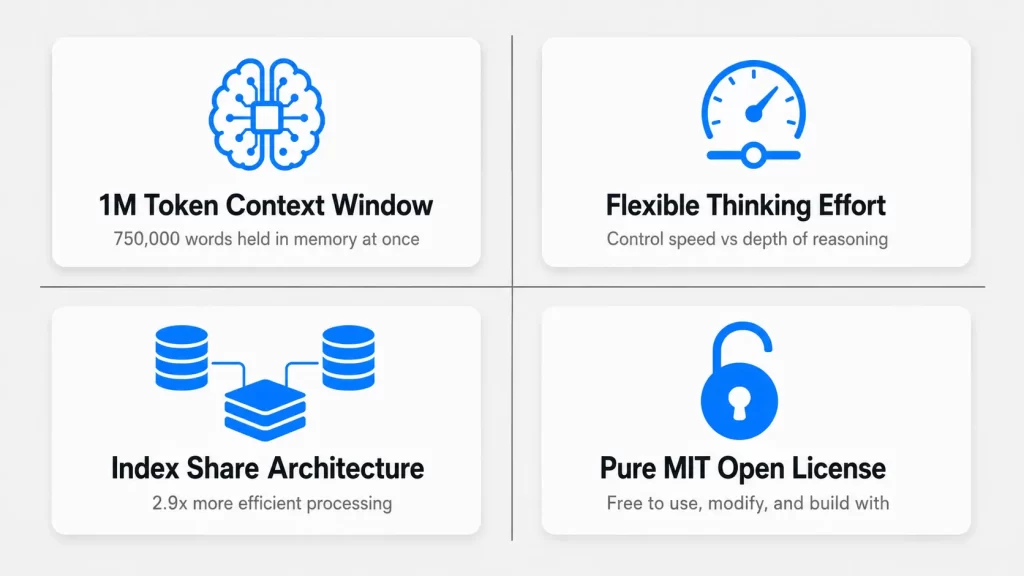
Before I get into those four things, there is one thing I want to mention upfront. GLM 5.2 comes with a pure open MIT source license and has no regional restrictions. That is not something you see often. Most open-weight models have some kind of limits. Some have usage restrictions. Some block certain regions. GLM 5.2 has none of that. You can download it, run it on your own machine, study it, change it, and build on top of it. That alone makes it worth knowing about.
Point 1: A Solid 1 Million Token Context Window
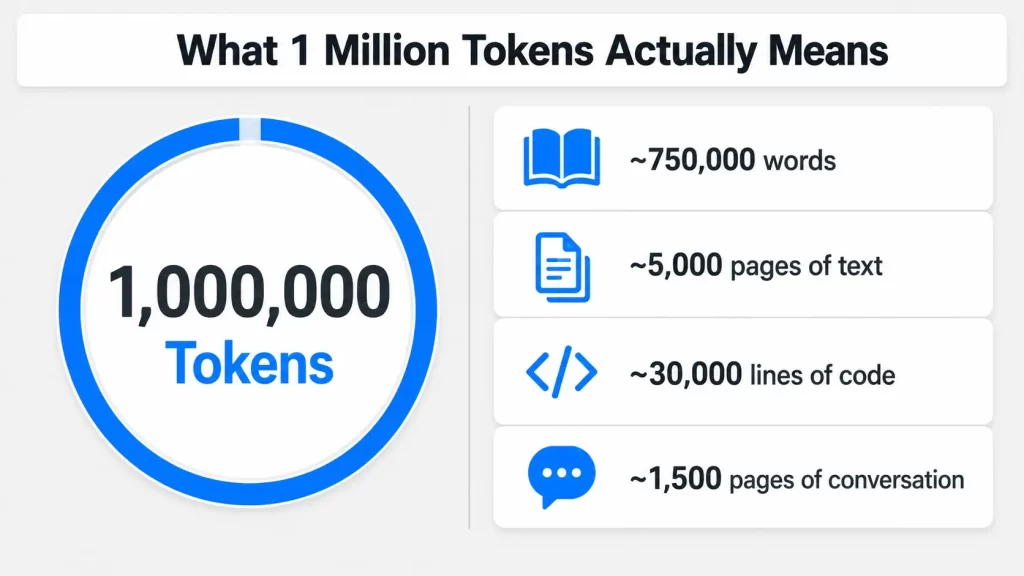
The first thing that got me excited about GLM 5.2 is its 1 million token context window. And the good part is that it keeps its performance even at that full length.
For people who are not sure what tokens mean, here is a simple way to think about it. A token is basically one small piece of text, close to one word. So 1 million tokens works out to around 750,000 words. That is about 5,000 pages of text, or 30,000 lines of code, or around 1,500 pages of chat, all inside one context window.
In simple words, the model can hold a huge amount of information in its memory at one time. It keeps everything in mind and gives you accurate answers without losing track of what you said earlier.
This is a big deal because one of the most annoying things about working with AI models is when they forget what you told them earlier in a long conversation. With 1 million tokens of context, that problem basically goes away.
Here is what this makes possible:
- You can give it a full book, a long research paper, or a complete report and it will read everything in one go
- You can work with a large codebase and many files at the same time
- You can have long conversations without the model forgetting your earlier instructions
- You can handle big tasks that have many steps
Now, you might be thinking that other models like OpenAI’s GPT 5.6, Claude, and Gemini also offer large context windows. That is true. But here is the key difference. GLM 5.2 is an open-weight model. If you have a powerful enough machine, you can run this model completely free on your own computer. No API fees, no subscriptions. That changes things a lot.
Point 2: Flexible Thinking Effort for Coding and Problem Solving
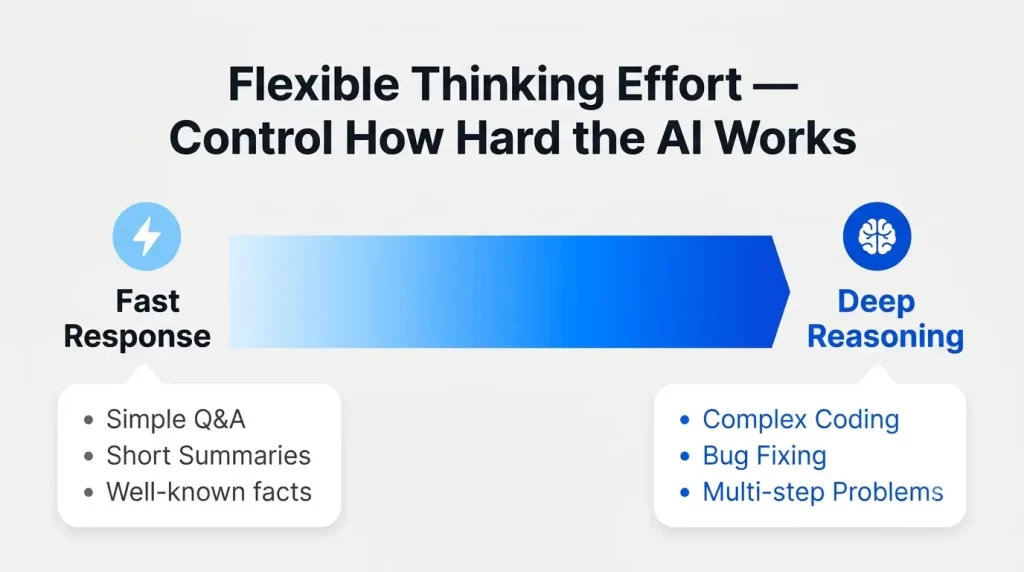
The second thing that makes GLM 5.2 interesting is what the team calls flexible thinking effort. In simple words, you can control how much thinking the model does before it gives you an answer.
More thinking means the model goes deeper and gives more accurate results. Less thinking means the model responds faster.
This is how all AI models work at some level. But GLM 5.2 lets you control this directly. Here is how to think about it:
Faster, less thinking works well for things like:
- Simple questions like “What is the capital of Japan?” The answer is Tokyo. No deep thinking needed here.
- Summarizing a short piece of text
- Basic tasks where the answer is already well known
Deeper thinking is better for:
- Complex coding tasks with many steps
- Hard problems that need careful reasoning
- Tasks where getting the right answer really matters
Faster responses use less computing power, so they cost less. Deeper reasoning uses more power but gives better results.
For example, if you want to build a simple login page, the model does not need to think too hard because the code for that is well known. But if you are solving a tricky bug or building something complex, deeper thinking is worth it.
When you pair this flexible thinking with the 1 million token context window, the model becomes very efficient. It uses the right amount of effort for each task, and that keeps costs down.
Point 3: Better Architecture with Index Share
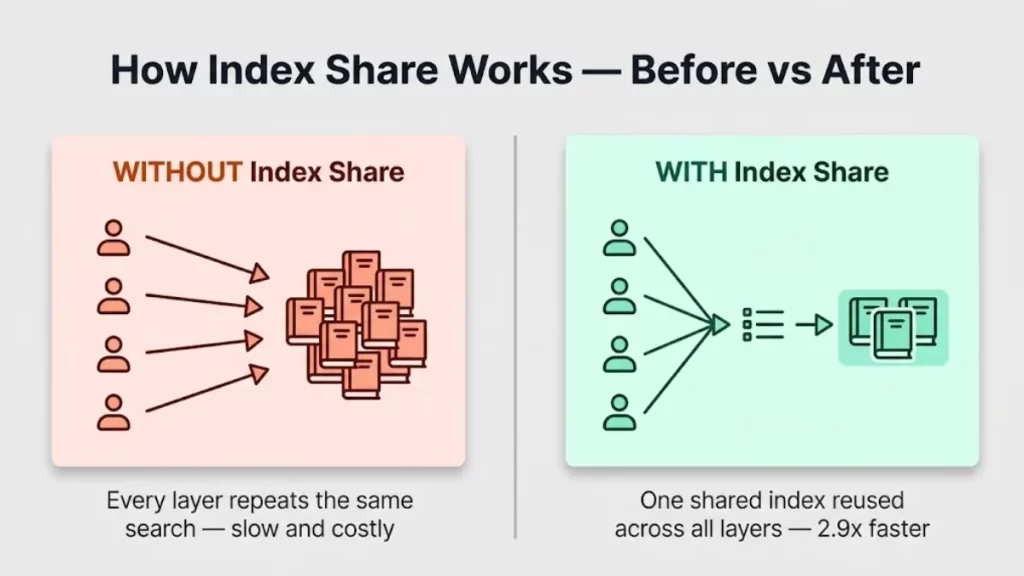
The third point is about how the model is built inside. The team added something called index share, and it is worth understanding because it is what makes the model so efficient.
The model reuses the same index across every layer it processes. This cuts the computing work by 2.9 times at the 1 million token context length. That is a big improvement.
Here is the simplest way I can explain this. Imagine a library with 10,000 books. Without index share, every person who walks in has to search through all 10,000 books to find the useful ones. Person A finds books 15, 213, and 901. Person B walks in the next day and does the same search. Person C after that. Everyone repeats the same work over and over.
With index share, the first person does the search and writes down a list of the useful books. Every person after that just uses that list. The hard work is done once, and everyone else gets the benefit.
That is what index share does inside the model. It creates one shared list and reuses it across all the layers. This means less work, less cost, and better speed, especially when you are working with a lot of text.
The team also improved another part of the model called empty player for decoding, which pushes the acceptance rate up by 20%. The result is a model that does more with less.
Point 4: Pure Open MIT Source License
I mentioned this at the start, but it deserves its own section because it really matters.
GLM 5.2 runs on a pure open MIT source license with no regional limits. Here is what that means in plain words:
- Free to use: Anyone can use it
- Free to study: You can look at how it works
- Free to change: You can adjust it for your own needs
- Free to build with: You can create products and services using it
This is good news for developers, researchers, and anyone who wants to use a powerful AI model without paying big subscription fees. The model is available on Hugging Face and because it is open source, there are already 26 providers offering it on OpenRouter.
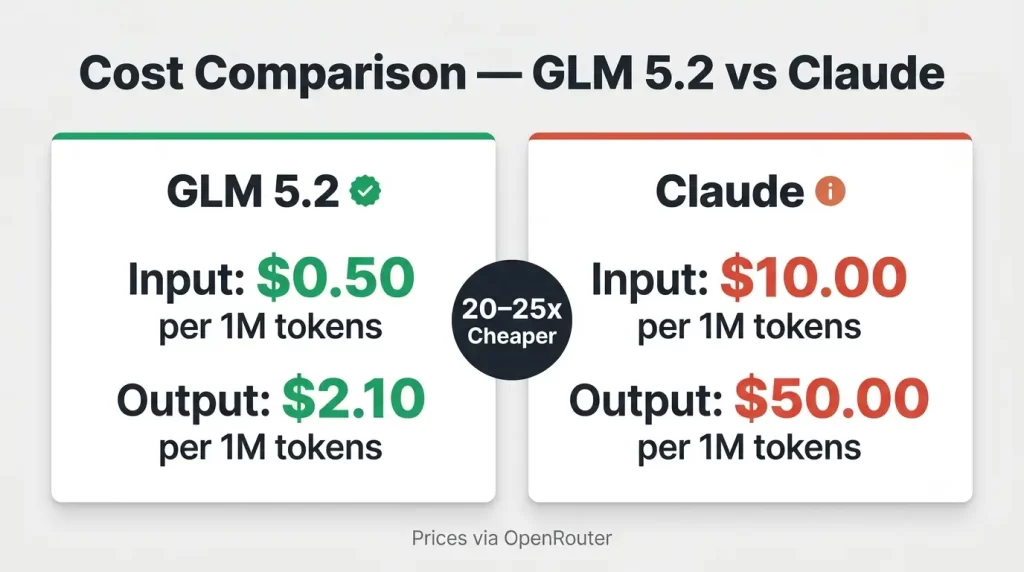
The price difference compared to other big models is really striking. On OpenRouter, you can use GLM 5.2 for as low as $0.50 per million input tokens and about $2.10 per million output tokens. Compare that to Claude, which costs around $10 per million input tokens and $50 per million output tokens. That is about 20 times more expensive for input and 25 times more expensive for output. GLM 5.2 is the cheapest model available at that context window size, with a confirmed 1.05 million token context window.
One thing I want to be honest about: because this is an open model, you do not always know exactly what data it was trained on. So you are using it at your own risk. That is something to think about if you are working with sensitive information.
Also worth knowing: GLM 5.2 is text only right now. It does not support images, voice, video, or files. Claude and Gemini both support these things. So if your work involves images or audio, you will still need those tools for that part.
How GLM 5.2 Ranks on Benchmarks
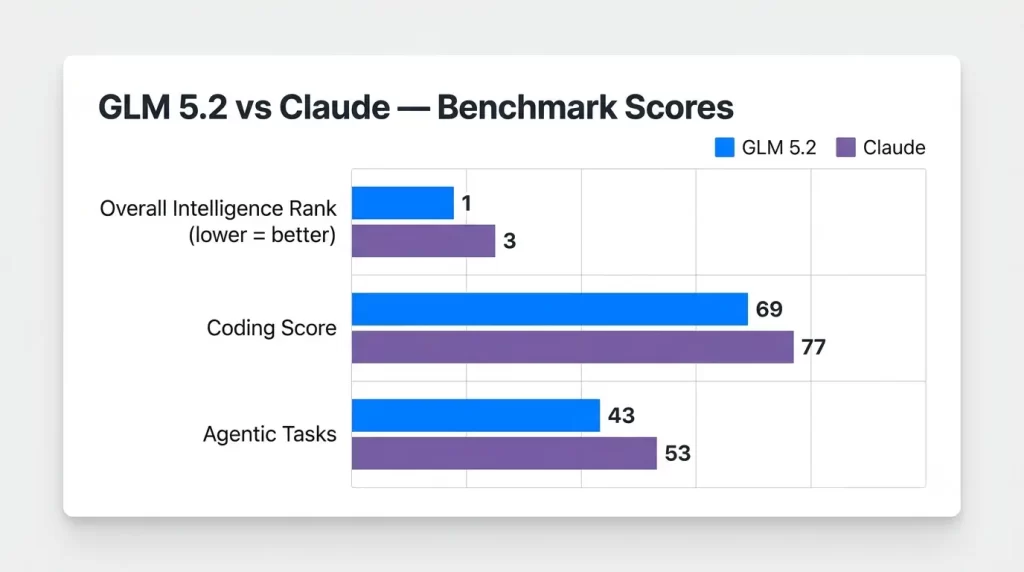
On the intelligence benchmark on OpenRouter, GLM 5.2 ranks 51st overall, sitting very close to Claude which is around 53rd. For coding, GLM 5.2 scores 69 compared to Claude’s 77. For tasks where the AI has to take actions and make decisions on its own, GLM 5.2 scores 43 compared to Claude’s 53.
On the LM leaderboard for text inputs, GLM 5.2 ranks number five in the world. That is a strong result for an open-weight model. It works especially well for coding and text generation.
I Tested It Myself: Here Is What I Found
I ran GLM 5.2 through a few real tests and compared the results with Gemini and Codex.
Test 1: Building a Hotel Website
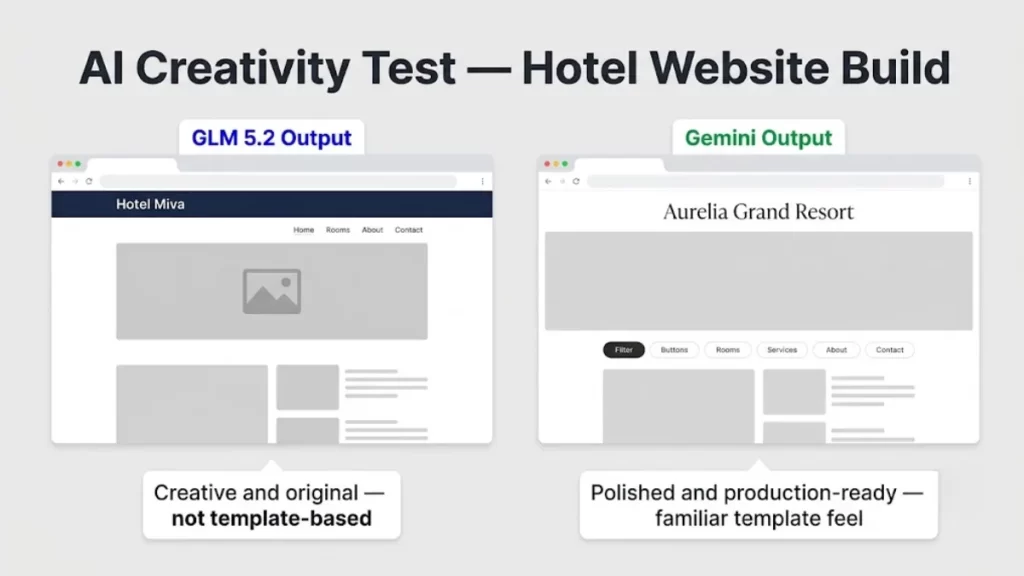
I gave all three models the exact same prompt: build a website for a hotel business. Here is what happened:
- GLM 5.2 created a one-page website called “Miva.” It was simple with placeholder images, but it felt creative. I could tell right away that the model was not using a ready-made template.
- Gemini created a beautiful, almost ready-to-use website called “Aurelia Grand Resort and Spa.” It had working room filters, a booking flow, multiple pages, and a polished look. One of the best AI-built websites I have seen.
- Codex also created a website and named it “Aurelia.”
Two totally different models, same prompt, same hotel name: Aurelia. That is not a coincidence. It looks like Gemini and Codex are pulling from the same kind of template data. They have seen so many hotel websites during training that they just reproduce a similar version each time.
GLM 5.2 named its hotel “Miva,” which is a completely original name. To me, that shows the model is being more creative rather than just copying a pattern. The website was not as polished as Gemini’s, but it was clearly not a copy of a template.
Test 2: Building a YouTube Business Website
I used the same prompt for all models to build a website for my YouTube business. GLM 5.2 created a clean, simple site called “Our Digital Ecosystem” with my channels listed and a clear layout. I also tested GLM 5 Turbo, the lighter version that is available when 5.2 is at full capacity. Interestingly, Turbo actually did a slightly better job here. The layout was cleaner and the icons were better placed.
Gemini created a very polished, text-heavy site with the headline “Stories That Move People, Content That Builds Brands.” I could honestly put that site live today. But I could also immediately tell it was made by Gemini. The style is very familiar.
Test 3: Writing Social Media Content
This is where GLM 5.2 really works well for what I do. I gave it background from one of my videos about WP Rocket, a WordPress speed plugin. I asked it to write a social media post with hashtags, plus two simple slides that explain the problem and what the plugin solves.
The post it wrote was really good. It started with a clear problem, explained what WP Rocket does, and included the right hashtags. My prompt was not even that clean, and the model still pulled out the right message.
For generating actual images for infographics, my other tools still work better. But for writing posts, building content, and generating text, GLM 5.2 is very strong.
How to Try GLM 5.2 for Free
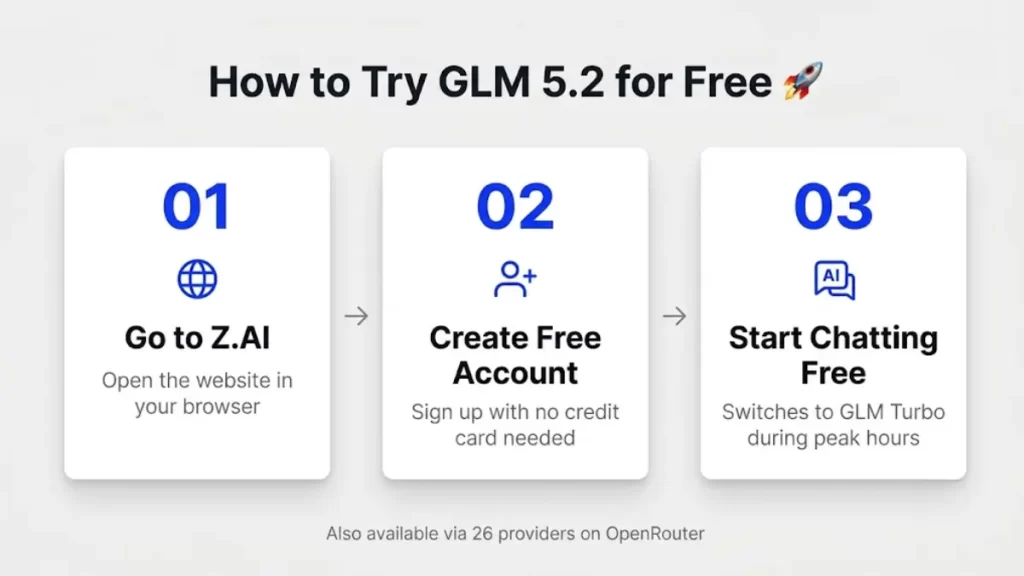
If you want to try GLM 5.2 without paying anything, go to Z.AI and create a free account. You can use the model right there in the browser. One thing to know: during busy hours in the daytime, the model may hit its limit and switch you over to GLM 5 Turbo automatically. Do not worry about that. Turbo is also a solid model. In some of my tests, it actually gave better results than 5.2 for certain tasks.
If you want to access GLM 5.2 through third-party tools, OpenRouter has 26 providers offering it right now, so you have lots of options when it comes to pricing and availability.
My Final Thoughts
GLM 5.2 is a real step forward for open-source AI. It does not beat every model at everything. But it changes what is possible for people who want a powerful model without the high cost.
An open-weight model with 1 million token context, adjustable thinking, a smarter internal design, and prices that are 20 to 25 times lower than the big models is worth paying attention to.
It does have limits. It is text only, so it cannot handle images or audio yet. Running it on your own machine requires very powerful hardware. And since it is open, you do not always know what it was trained on.
But for writing, coding, long text tasks, and high-volume content work, GLM 5.2 shows that you do not always need the most expensive model to get good results.
I am going to keep using it and testing it. If you are building something or creating content and cost matters to you, it is worth giving GLM 5.2 a try.
Have you tried GLM 5.2 yet? What do you think about it? Share your thoughts in the comments. I would love to know what you are finding.
Is GLM 5 Chinese?
Yes it is Chinese Open Weight Model with 753 billion Parametres
Is GLM better than GPT 5.6 sol?
In somebechmarks it shows better scores that GPT 5.6 sol. But it really depends on the task you are using it for.
Is a GLM 5.2 really good?
Yes, GLM 5.2 is really good model for long horizon tasks. specially it comes with 1Million Token Context Window and it’s very cost-effective.
Is GLM 5.2 free to use?
yes, you can use it free at Z.Ai web interface.